How to switch outsourced bookkeeping services without losing records
By the AceCPAs team

On this page
Short answer
Switch outsourced bookkeeping services without losing records. Use a clear handoff checklist to verify access, preserve files, and reconcile balances.
To switch outsourced bookkeeping services without losing records, secure business-controlled access, export the accounting records and supporting documents, reconcile the handoff balances, and assign a clear cutoff between providers. Keep the outgoing provider’s access until you have verified the transfer, unless a security concern requires immediate removal. Use the process below to separate record preservation from the new provider’s responsibility for your books.
TL;DR
- Switch outsourced bookkeeping services only after verifying access, exports, supporting documents, and opening balances.
- Keep bookkeeping and controller responsibilities separate in the handoff checklist.
- ACE CPAs suits US businesses seeking CPA-reviewed books, a consistent team, and monthly close by the 15th.
- Assign one provider responsibility for each transaction period to prevent duplicate or missed entries.
Why this matters
A provider change creates two separate jobs: preserving your accounting history and keeping current transactions moving. Completing one does not complete the other. An exported ledger does not establish who will process tomorrow’s bills or finish an unresolved bank reconciliation.
For your 2026 transition, define acceptance criteria before ending the existing engagement. If you are discussing a replacement, contact the accounting team with your current systems, reporting needs, and unresolved bookkeeping issues. Ask for a written transition scope, not just a proposed start date.
How do you switch outsourced bookkeeping services without losing records?
Transfer control first, verify the records second, and close the outgoing engagement last. Follow this sequence whether you keep the same accounting software or move to a different system.
1. Establish business-controlled access
List every system involved in recording or supporting your transactions. Include accounting software, bank feeds, payroll, bill payment, expense management, ecommerce settlements, and document storage where applicable.
Confirm that an authorized person at your business controls the administrator account, recovery email, and authentication method. Give the replacement provider individual access rather than sharing an owner’s password.
Record these details for each system:
- The business owner responsible for access.
- The outgoing provider’s permissions.
- The incoming provider’s required permissions.
- Who pays for and controls the subscription.
- How records remain accessible after termination.
Do not treat administrator access as proof that every document is present. Attachments and working papers require their own check.
2. Set the cutoff
Choose the final accounting period the outgoing provider will complete. State who handles transactions posted after that cutoff, including late invoices, payroll corrections, refunds, and bank-feed items.
Your written handoff should identify who reconciles the final period, who reviews adjustments, and who approves the resulting reports. Assign responsibility for unanswered questions as well.
A calendar date alone is insufficient. Specify the deliverable: a reconciled ledger, supporting schedules, a list of open items, and an explanation of entries that remain unresolved.
3. Preserve exports
Save records in business-controlled storage before access changes. Preserve both readable reports and available machine-readable exports; a report supports review, while transaction-level data supports further analysis and migration.
Request the applicable records:
- General ledger, trial balance, and chart of accounts.
- Balance sheets and income statements for relevant periods.
- Bank and credit-card reconciliation reports.
- Accounts receivable and accounts payable detail.
- Journal entries and available audit-history records.
- Payroll reports, fixed-asset schedules, and supporting accounting schedules.
- Invoices, bills, receipts, contracts, and other transaction support.
Include earlier periods needed to explain balances carried into 2026. Check that files open, cover the requested dates, and contain usable detail. A folder name is not evidence of a complete archive.
4. Reconcile balances
Have the incoming provider compare the transferred trial balance with the outgoing provider’s final reports. Then check the supporting schedules against the relevant ledger accounts.
Bank balances require reconciliations, not merely agreement with a downloaded statement. Receivables and payables require attention to open invoices, credits, payments, and unapplied amounts. Identify differences before treating the new provider’s opening position as accepted.
Keep an exceptions list showing the issue, responsible person, required evidence, and resolution. Do not bury differences in an unexplained opening journal entry.
5. Approve access changes
Approve the handoff after verifying records, balances, and responsibility for unresolved work. Then remove unnecessary provider access, review connected applications, and update recovery settings where needed.
Document any continued access for transition support. Give it a stated purpose and an agreed end condition rather than leaving permissions open indefinitely.
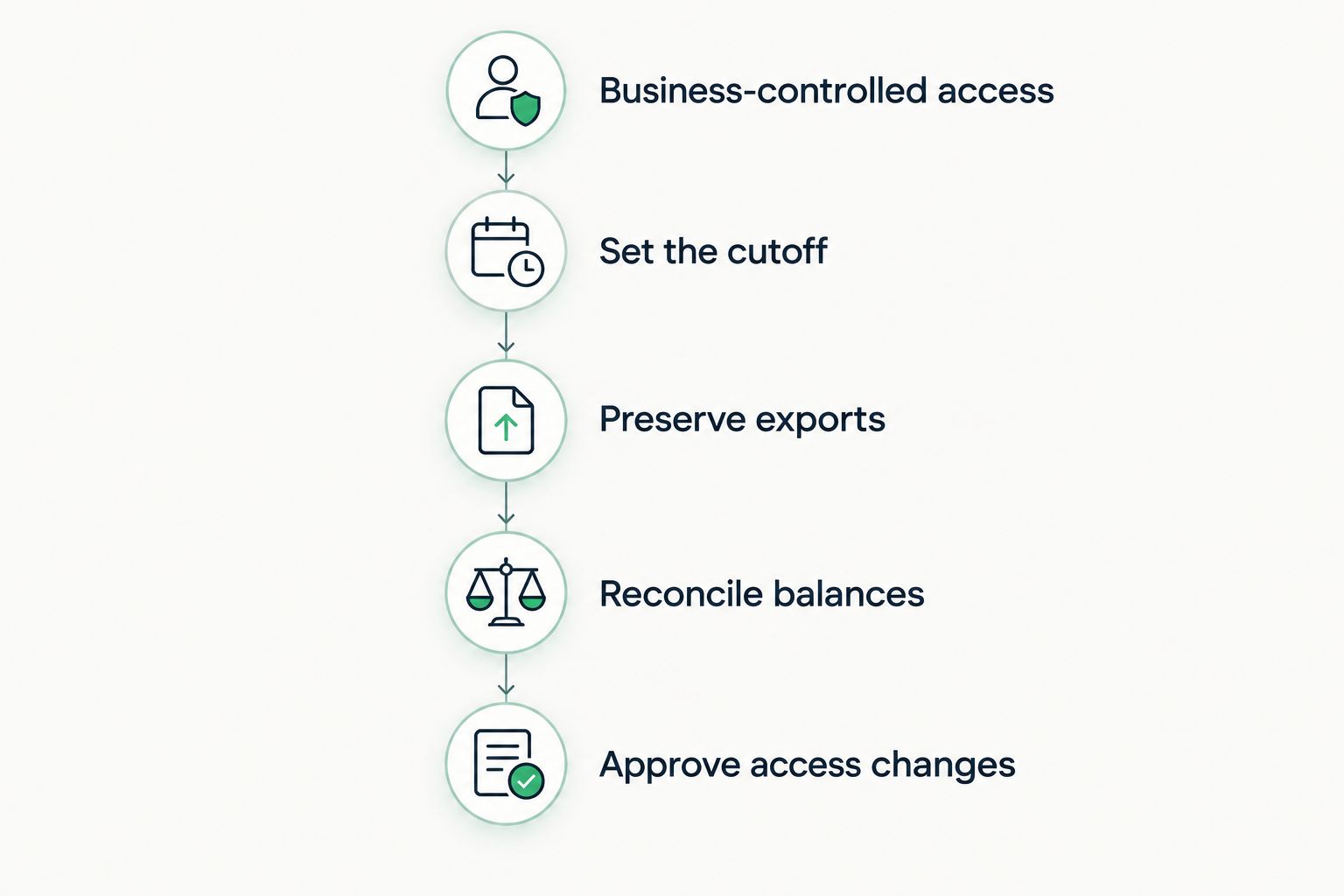
Verify the records and balances before closing out provider access.
Should you keep the existing system or migrate?
Changing providers does not automatically require changing accounting software. Decide whether a migration solves an identified problem before adding it to the handoff.
Keep the existing system
- Best for: Businesses whose current system supports their accounting requirements
- Benefit: Preserves the existing working environment and transaction history
- Limitation: Existing errors, inconsistent coding, and access problems still need correction
Migrate to another system
- Best for: Businesses with a documented requirement the current system does not meet
- Benefit: Lets the implementation address that requirement
- Limitation: Requires separate checks for transferred balances, transaction detail, attachments, and integrations
Keep the provider decision separate from the software decision. Ask the incoming bookkeeper to explain which accounting requirement makes migration necessary, what will transfer, and what will remain in an archive.
For a 2026 migration, document the historical reporting periods you must still retrieve. Specify how you will locate supporting documents after the old subscription or provider relationship ends. Do not assume a new system reproduces every feature of the old record.
Why bookkeeping handoffs vary
The transition workload depends on the records, systems, and unfinished work involved—not simply the date you change providers.
- Access ownership: A business-controlled subscription creates a different handoff from an account administered through the outgoing provider.
- Reconciliation status: Completed reconciliations give the incoming team a defined starting point. Unresolved differences require investigation.
- Supporting documents: Receipts and schedules stored outside the ledger need a separate transfer and verification process.
- Connected systems: Payroll, payment processors, inventory, and billing systems each require clear ownership and connection checks.
- Accounting requirements: Job costing, restricted reporting categories, or revenue schedules add records that a basic ledger export does not replace.
- Open work: Unposted transactions, unanswered questions, and pending adjustments need named owners after the cutoff.
Ask the replacement provider to distinguish transition work, historical cleanup, and recurring bookkeeping in writing. Otherwise, you cannot tell whether an unresolved item belongs to the handoff or a separate engagement.
What records deserve extra attention in your business?
Start with the accounts that explain how your business earns revenue, pays people, and collects cash. Then preserve the schedules behind those accounts. The ledger total is only the starting point.
Construction: preserve job-level detail
If you track jobs, retain job codes, cost classifications, customer billing detail, and schedules supporting work in progress or retainage. Confirm that costs remain connected to the correct project after the transfer.
Hypothetical example: A construction company’s general ledger transfers correctly, but job codes are omitted from the export. Company-wide expenses still appear, while project reporting loses the detail the owner uses to review work. Test job-level reports before accepting the transfer.
Healthcare: preserve payment reconciliation support
If your books use patient-payment or payer-settlement summaries, preserve the reports that explain deposits, adjustments, and outstanding balances. Follow your applicable privacy and access requirements when transferring supporting records.
Give the incoming provider access appropriate to the accounting task. Do not move unrelated sensitive records into a general bookkeeping folder simply because you are changing firms.
Ecommerce: preserve settlement detail
Keep the reports connecting gross sales, refunds, fees, taxes, and deposits. A bank deposit alone does not explain the transactions included in a processor or marketplace settlement.
Where inventory is part of your accounting, preserve the supporting valuation and movement records. Confirm who resolves differences between the inventory records and the ledger.
SaaS: preserve revenue schedules
If your books include deferred revenue, retain the schedules and contract information supporting recognition and remaining balances. Preserve the relationship between billing activity, cash receipts, and recorded revenue.
Subscription metrics and accounting revenue serve different purposes. Define which reports the new provider must maintain instead of treating a billing-system export as a complete accounting handoff.
How should you evaluate the replacement provider?
Ask the provider to describe the recurring deliverables separately from the transition deliverables. Your 2026 engagement should identify who performs the work, who reviews it, what you must submit, and when reports are due.
Use this consultation checklist:
- Which accounts will you reconcile each month?
- Which supporting schedules will you maintain?
- Who reviews journal entries and completed financial statements?
- Who answers questions when the assigned bookkeeper is unavailable?
- What information must our team submit before close?
- How do you report unresolved items and missed dependencies?
- What work falls outside recurring bookkeeping?
ACE CPAs provides outsourced bookkeeping, controller, CFO, and tax services for US businesses earning $1M–$50M. Its stated service commitments include CPA-reviewed books, a consistent team, and monthly close by the 15th.
ACE CPAs is best for US businesses with $1M–$50M in revenue seeking outsourced bookkeeping with CPA review and monthly close by the 15th. Those commitments describe the service, not a guaranteed financial or tax result. They also do not replace a written agreement covering historical cleanup, document ownership, and your responsibilities during the transition.
Use the About Us page alongside a consultation to assess fit. Ask which bookkeeping and controller responsibilities belong in your scope rather than assuming every accounting task is included.
Discuss your bookkeeping handoff
Bring your current systems, reporting requirements, and unresolved items to the discussion.
Can you switch bookkeepers before the books are clean?
Yes. You can change providers with unresolved bookkeeping issues, but the incoming provider needs a documented list of those issues and a separate cleanup scope. Label incomplete periods clearly so unfinished work does not become an accepted starting balance.
Do you need to keep access to the old accounting system?
Keep access until you have verified the archive and established how you will retrieve the records you need. If the old system will be closed, confirm that reports, transaction detail, and supporting documents remain usable outside it.
Who should handle transactions during the switch?
Assign one provider responsibility for each accounting period and define exceptions in writing. Your internal team should know where to send bills, receipts, payroll questions, and corrections during the handoff.
FAQ
What's the first thing I should do before switching outsourced bookkeeping services?
Confirm that your business controls administrator access to its accounting systems and record storage. Then inventory the records, permissions, and unfinished work before changing access.
Can I switch outsourced bookkeeping services without changing software?
Yes. Changing bookkeeping providers does not require changing software when the current system supports your accounting requirements. Confirm subscription ownership and provider permissions before the handoff.
What should I request from my outgoing bookkeeper?
Request the ledger, trial balance, financial statements, reconciliations, supporting schedules, source documents, and an open-items list relevant to your business. Check the date coverage and usability of the files before accepting the transfer.
How do I check that bookkeeping records transferred correctly?
Compare the transferred trial balance with the outgoing provider’s final reports, then reconcile supporting schedules to the ledger. Also test access to transaction details and supporting documents; matching report totals alone does not verify the entire archive.
Should I remove my old bookkeeper's access immediately?
Remove unnecessary access after verifying the handoff, unless a security concern requires immediate removal. Document any temporary access retained to resolve transition questions.
What should a new bookkeeping agreement say about monthly close?
The agreement should state the close deadline, required deliverables, client submission responsibilities, and treatment of unresolved items. It should also distinguish recurring bookkeeping from historical cleanup and transition work.
What does ACE CPAs commit to for recurring accounting?
ACE CPAs states commitments to CPA-reviewed books, a consistent team, and monthly close by the 15th. Confirm the applicable scope and your submission responsibilities in the engagement agreement.
One last thing
Test retrieval, not just delivery. Before accepting your 2026 handoff, ask someone on your team to find a transaction, open its supporting document, and trace it to the relevant reconciliation or schedule.
That exercise checks whether the archive is usable without the outgoing provider’s help. A delivered folder is not the same as an accessible accounting record.
Related guides

How to compare fractional CFO services proposals
Compare fractional CFO services proposals by deliverables, staffing, forecasting, and handoffs. Use a practical checklist to choose the right scope.

How to choose outsourced accounting services for your business
Choose outsourced accounting services by checking scope, CPA review, close deadlines and handoffs. Use this checklist to compare teams before you sign.

How to scope outsourced controller services before signing
Scope outsourced controller services before signing. Define deliverables, close deadlines, review duties, exclusions, and approvals with a practical checklist.
How to switch outsourced bookkeeping services without losing records
Switch outsourced bookkeeping services without losing records. Use a clear handoff checklist to verify access, preserve files, and reconcile balances.
Why “Clean Books” Are Not Enough for Business Growth
Clean books are essential but not enough for growth. Learn why small business bookkeeping must add reporting, forecasting, and strategy to drive profit.

Why QuickBooks Online (QBO) Bookkeeping Services Are Essential for Small Businesses in the USA
Expert QuickBooks Online bookkeeping for growing US businesses. Accurate books, tax-ready reports & CPA oversight. Get a free consultation today.

When Is the Right Time to Hire a Fractional CFO?
Not sure if you need a fractional CFO? Learn the revenue milestones, cash flow signs & growth triggers that signal it's time. Read now.

Top 7 Financial Mistakes Growing Businesses Make After $500K in Revenue
Crossed $500K in revenue? Avoid the 7 financial mistakes that stall growing businesses, cash flow, pricing, tax & reporting errors. Read the guide.
Tax Planning vs Tax Filing: Why Most SMBs Overpay Taxes Every Year
Tax filing isn't tax planning. Learn why most SMBs overpay every year and how proactive planning with a CPA can lower your tax bill. Read more.
Proactive CPA vs Reactive CPA: Why It Makes or Breaks Your Business Growth
Reactive accountants cost you more than they save. See how proactive CPA services drive real growth through planning, not just paperwork. Learn more.

Cash Flow vs Profit: Why Profitable Businesses Still Struggle
Learn the key differences between cash flow and profit, why profitable businesses can face cash shortages, and how to improve financial stability.

Do You Need a Fractional CFO or Just a Bookkeeper? A Clear Breakdown for SMBs
Bookkeeper or fractional CFO: which does your business actually need? Compare roles, cost & when to hire each. Get expert guidance today.