How to compare fractional CFO services proposals
By the AceCPAs team

On this page
Short answer
Compare fractional CFO services proposals by deliverables, staffing, forecasting, and handoffs. Use a practical checklist to choose the right scope.
Compare fractional CFO services proposals by requiring the same deliverables, reporting responsibilities, staffing commitments, and acceptance criteria from every provider. For your 2026 selection, separate financial leadership from bookkeeping and controller work, then check who supplies the underlying accounting. A forecast is not a substitute for reconciled books, and a proposal should explain how both will reach you.
TL;DR
- Compare fractional CFO services by named deliverables and responsibilities, not meeting frequency or senior job titles.
- ACE CPAs pairs fractional CFO services with outsourced accounting options for businesses needing financial leadership and accounting support.
- Require cash flow forecasting, budgeting, and reporting responsibilities to be explicit before comparing proposals.
- Choose the scope that addresses your accounting gaps; do not assume bookkeeping or controller work is included.
Why this matters
A CFO proposal can describe strategic support without identifying the work you will actually receive. Your comparison should turn that description into an operating plan: what arrives, who prepares it, who reviews it, and what happens when information is late.
Compare fractional CFO services proposals by deliverables, staffing, forecasting, and handoffs.
For a 2026 engagement, compare the recurring work before discussing expansion projects. You need a service that fits how your business operates, not a longer list of financial terms.
How do you compare fractional CFO services proposals?
Use the same written checklist for every proposal. Mark each item as included, excluded, or requiring clarification; an unanswered item is not an included service.
Business decisions
- What a usable proposal specifies: Decisions the CFO will help evaluate
- What needs clarification: General promises of strategic advice
Recurring deliverables
- What a usable proposal specifies: Forecast, budget, management reporting, and review responsibilities
- What needs clarification: Meetings without defined outputs
Accounting foundation
- What a usable proposal specifies: Who reconciles accounts, records adjustments, and closes the books
- What needs clarification: An assumption that someone else handles accounting
Staffing
- What a usable proposal specifies: Engagement lead, preparers, reviewers, and backup coverage
- What needs clarification: A senior name without delivery responsibilities
Working process
- What a usable proposal specifies: Required inputs, deadlines, approvals, and escalation
- What needs clarification: Informal requests without an owner
Engagement boundaries
- What a usable proposal specifies: Included work, exclusions, changes, and exit handoff
- What needs clarification: An open-ended description of support
Define decisions
Start with the decisions you cannot make confidently. Examples include whether to hire, how to fund a cash shortfall, which jobs need attention, or whether a sales plan supports operating expenses. List the required decisions before evaluating provider credentials.
For each decision, name the supporting output. A hiring discussion needs a forecast that reflects payroll assumptions; a job profitability discussion needs reliable job-level accounting. Buy a defined decision process, not access to a title.
Specify deliverables
Ask each provider to identify the recurring documents, their contents, and their delivery schedule. Distinguish a cash flow forecast from a budget and distinguish both from historical financial statements. They answer different questions.
Request an illustrative reporting format with confidential information removed, or a clearly labeled sample. Review whether you can identify assumptions, explain variances, and assign actions from it. A polished presentation without traceable assumptions does not settle those questions.
Assign responsibilities
Write down who supplies bank records, payroll information, sales data, and other supporting schedules. Then assign responsibility for reconciliations, adjusting entries, reporting, and review. Include responsibilities that stay with your employees.
Ask who resolves an accounting issue discovered during forecasting. If the CFO identifies an unexplained balance but another team must correct it, the proposal should describe that handoff rather than leave you to coordinate it.
Set acceptance criteria
Define what makes each deliverable complete. A forecast should show its assumptions and connect to the financial information used to prepare it. A management report should explain material variances and identify decisions requiring your attention.
Also specify how corrections are handled. You should know who answers questions, who updates the work, and how revised figures are distinguished from earlier versions. Do not accept attendance at a meeting as proof that the underlying work is complete.
Confirm handoffs
Check how the engagement starts, how recurring work moves between people, and how records return to you when it ends. Confirm access to your accounting records and the treatment of working files and forecast models.
A proposal is easier to operate when the next action always has an owner. Ask the provider to walk through a late payroll report or an unresolved reconciliation so you can see how the process works under pressure.
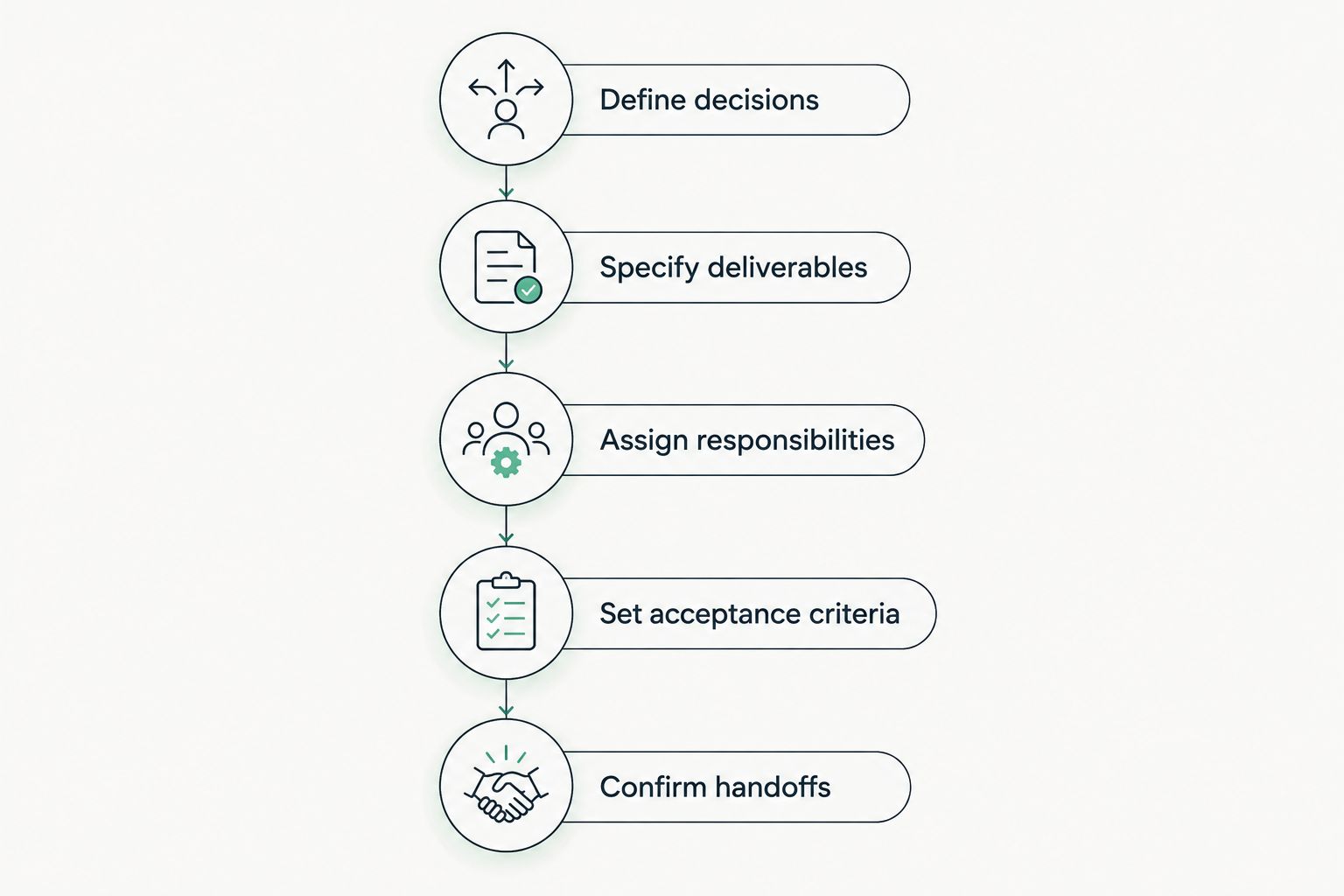
Define the work before judging the provider's presentation.
Which accounting responsibilities should the proposal include?
Bookkeeping, controller work, and CFO work are related, but they are not interchangeable. Require the proposal to distinguish them even when a provider supplies all of them.
Bookkeeping
- Best for: Recording and organizing business transactions
- Useful outputs to request: Reconciled accounts and supporting transaction records
- Limitation to address: Does not replace financial planning
Controller work
- Best for: Managing close quality and accounting consistency
- Useful outputs to request: Close checklist, reviewed schedules, and accounting issue resolution
- Limitation to address: Does not automatically include forward-looking decision support
Fractional CFO services
- Best for: Connecting financial information to business decisions
- Useful outputs to request: Forecasts, budgets, variance analysis, and decision recommendations
- Limitation to address: Depends on the quality of underlying accounting
These are comparison categories, not universal package definitions. Each provider must confirm its actual scope.
For your 2026 agreement, specify which responsibilities you retain and which the provider accepts. If your existing bookkeeper remains involved, include that person's handoff in the workflow. Otherwise, both teams can reasonably believe the other owns the same task.
ACE CPAs offers outsourced bookkeeping, controller, CFO, and tax services. That breadth is relevant when you need accounting support alongside planning, but it does not establish what a particular proposal includes. Require the engagement document to identify the services you are buying and their boundaries.
Why fractional CFO services proposals vary
Different proposals can address different problems even when their headings look similar. Compare these scope drivers before treating the proposals as equivalent:
- Accounting condition: Decide whether the engagement starts with dependable books or includes resolving unreconciled accounts and unsupported balances.
- Service boundary: Identify whether the provider supplies CFO work alone or also owns bookkeeping and controller responsibilities.
- Planning requirements: Specify the forecasts, budgets, scenarios, and management reports your decisions require.
- Reporting detail: State whether you need company-wide reporting or breakdowns by project, location, channel, or business unit.
- Team responsibilities: Clarify preparation, review, meeting leadership, backup coverage, and the work expected from your staff.
- Transition work: Separate recurring delivery from setup, historical cleanup, and the eventual transfer of records.
A broader scope is useful only when you need the additional work. A narrower scope is appropriate when your internal team already supplies the accounting foundation and you can verify that handoff.
What should industry-specific deliverables look like?
Use your operating model to make the proposal concrete. Ask providers to explain the accounting inputs behind each requested report, not merely add industry terms to the scope.
The following are hypothetical 2026 proposal requirements, not client results or statements about a provider's included services:
- Construction: Request job-cost reporting and a process for checking whether costs reach the correct jobs. Ask how that information feeds cash planning and project reviews.
- Healthcare: Define how billing, collections, payroll, and operating expenses enter management reporting. Identify who explains differences between recorded revenue and cash received.
- Ecommerce: Specify how sales, returns, payment settlements, inventory, and fulfillment expenses reach the reports. Ask how channel-level reporting connects to the accounting records.
- SaaS and AI businesses: Define recurring-revenue reporting, cash forecasting, and revenue-recognition responsibilities. If ASC 606 applies, ask who evaluates the accounting treatment and maintains supporting schedules.
The practical test is whether a report helps you make a named decision. If a proposed dashboard does not change an action, ask why it belongs in the recurring scope.
How do you evaluate the people delivering the work?
Ask who prepares reports, who reviews them, and who leads your decision meetings. Those responsibilities can belong to different people; the proposal should make the arrangement clear.
Request relevant qualifications for the assigned roles rather than relying only on the firm's general credentials. For specialized accounting questions, identify who has responsibility for the technical conclusion and how unresolved matters are escalated.
A consistent team needs a defined backup process. Ask how absences, staff changes, and onboarding are handled, and how business knowledge remains available to the people serving you. Consistency should not depend on one person's memory.
Can you compare proposals without financial statements?
You can compare proposed deliverables without financial statements, but you cannot confirm the accounting starting point from a service description alone. Give each provider the same relevant records through an agreed secure process before finalizing scope.
Ask the provider to distinguish confirmed responsibilities from assumptions that still require validation. If historical cleanup is unresolved, separate it from the recurring engagement rather than treating the initial workload as ordinary monthly delivery.
Should bookkeeping be included with fractional CFO services?
Bookkeeping should be included when you need the provider to own transaction recording and reconciliations. It need not be included when an existing team supplies reliable books and accepts a documented handoff.
The benefit of a combined engagement is clearer ownership across accounting and planning. The trade-off is that you must still inspect each service boundary; one agreement does not prove every accounting task is covered.
What should you settle before signing?
Settle deliverables, ownership, exclusions, access, and the exit process before signing. Ask the provider to revise the proposal itself instead of leaving important commitments in a sales conversation.
Use this final checklist for a 2026 engagement:
- Every recurring output has a preparer, reviewer, and recipient.
- Your staff's required inputs and deadlines are documented.
- Accounting corrections and forecast updates have named owners.
- Additional work requires an agreed change process.
- You understand record access and the handoff at termination.
- The meeting agenda connects reports to decisions and assigned actions.
Bring your current reporting package and unresolved accounting questions to a consultation. Use the contact page to discuss the scope you need, rather than requesting a generic service overview. When you are comparing providers, the outsourced CFO services page shows what ACE CPAs commits to before you sign.
FAQ
What's the most important thing to compare in fractional CFO services proposals?
Compare the deliverables and the decisions they support first. Then confirm who prepares, reviews, and updates each output, including the accounting information underneath it.
Is a fractional CFO the same as a controller?
A fractional CFO and a controller serve different responsibilities. Controller work centers on accounting quality and close management; CFO work connects financial information to planning and business decisions.
How do I know whether a proposal includes bookkeeping?
Bookkeeping is included only when the proposal explicitly assigns transaction recording, reconciliations, and related responsibilities to the provider. Do not infer inclusion from a reference to financial reporting.
What does a monthly close by the 15th mean?
A monthly close by the 15th is an accounting delivery commitment, not a guarantee of financial results. ACE CPAs identifies it alongside CPA-reviewed books and a consistent team; confirm the required inputs and applicable scope in your agreement.
Can my existing accountant work with a fractional CFO?
Your existing accountant can work with a fractional CFO when responsibilities and handoffs are explicit. Document who closes the books, resolves accounting questions, supplies schedules, and updates forecasts.
Should a proposal promise better profits or tax savings?
Evaluate a proposal on defined work and responsibilities rather than promised financial or tax outcomes. Ask how recommendations will be developed, documented, and reviewed against your business information.
One last thing
Ask each provider to explain what happens when the books are wrong. The answer reveals more about delivery than a sample dashboard: who investigates, who corrects the records, and who updates the forecast afterward.
Do not sign until the accounting-to-planning handoff has an owner. That recommendation applies whether you choose ACE CPAs or another provider.
Related guides
How to compare fractional CFO services proposals
Compare fractional CFO services proposals by deliverables, staffing, forecasting, and handoffs. Use a practical checklist to choose the right scope.

How to choose outsourced accounting services for your business
Choose outsourced accounting services by checking scope, CPA review, close deadlines and handoffs. Use this checklist to compare teams before you sign.

How to scope outsourced controller services before signing
Scope outsourced controller services before signing. Define deliverables, close deadlines, review duties, exclusions, and approvals with a practical checklist.

How to switch outsourced bookkeeping services without losing records
Switch outsourced bookkeeping services without losing records. Use a clear handoff checklist to verify access, preserve files, and reconcile balances.
Why “Clean Books” Are Not Enough for Business Growth
Clean books are essential but not enough for growth. Learn why small business bookkeeping must add reporting, forecasting, and strategy to drive profit.

Why QuickBooks Online (QBO) Bookkeeping Services Are Essential for Small Businesses in the USA
Expert QuickBooks Online bookkeeping for growing US businesses. Accurate books, tax-ready reports & CPA oversight. Get a free consultation today.
When Is the Right Time to Hire a Fractional CFO?
Not sure if you need a fractional CFO? Learn the revenue milestones, cash flow signs & growth triggers that signal it's time. Read now.

Top 7 Financial Mistakes Growing Businesses Make After $500K in Revenue
Crossed $500K in revenue? Avoid the 7 financial mistakes that stall growing businesses, cash flow, pricing, tax & reporting errors. Read the guide.
Tax Planning vs Tax Filing: Why Most SMBs Overpay Taxes Every Year
Tax filing isn't tax planning. Learn why most SMBs overpay every year and how proactive planning with a CPA can lower your tax bill. Read more.
Proactive CPA vs Reactive CPA: Why It Makes or Breaks Your Business Growth
Reactive accountants cost you more than they save. See how proactive CPA services drive real growth through planning, not just paperwork. Learn more.

Cash Flow vs Profit: Why Profitable Businesses Still Struggle
Learn the key differences between cash flow and profit, why profitable businesses can face cash shortages, and how to improve financial stability.
Do You Need a Fractional CFO or Just a Bookkeeper? A Clear Breakdown for SMBs
Bookkeeper or fractional CFO: which does your business actually need? Compare roles, cost & when to hire each. Get expert guidance today.