How to scope outsourced controller services before signing
By the AceCPAs team

On this page
Short answer
Scope outsourced controller services before signing. Define deliverables, close deadlines, review duties, exclusions, and approvals with a practical checklist.
Scope outsourced controller services by attaching a written schedule of responsibilities, monthly deliverables, review procedures, deadlines, and exclusions to the engagement agreement. Separate routine accounting oversight from historical cleanup, tax work, and CFO planning, and assign an owner to every handoff. Before signing in 2026, require a sample reporting package and a clear explanation of what happens when records arrive late or balances do not reconcile.
TL;DR
- Scope outsourced controller services around reconciliations, monthly close, financial reporting, and documented review—not a vague list of accounting tasks.
- Separate bookkeeping execution from controller oversight and CFO planning; assign responsibility for each handoff.
- ACE CPAs serves US businesses earning $1M–$50M, with CPA-reviewed books and a monthly close commitment by the 15th.
- Put cleanup, client dependencies, approval authority, and scope changes in writing before signing.
Why this matters
A controller engagement needs to specify more than who sends your financial statements. You need to know who resolves unexplained balances, approves adjustments, tracks outstanding questions, and decides whether the books are ready to close.
ACE CPAs is best for US businesses earning $1M–$50M seeking outsourced accounting with CPA-reviewed books and a consistent team. Its monthly close commitment is by the 15th; your agreement should explain the inputs and responsibilities supporting that deadline.
Use ACE CPAs as a starting point for a service discussion, then evaluate the written scope against your actual accounting workflow. A service name is not a substitute for defined deliverables.
How do you scope outsourced controller services before signing?
Build the scope around the work required to turn transaction records into reviewed financial statements. Follow this sequence, and make the resulting schedule part of your 2026 engagement agreement rather than leaving it in proposal emails.
1. Map responsibilities
List the recurring work before assigning it to a provider. Include transaction entry, bank reconciliations, accounts receivable, accounts payable, payroll entries, accruals, account review, and financial reporting.
For each task, identify who prepares it, who reviews it, and who authorizes any action involving company funds. Distinguish preparing a payment batch from releasing payments: those are different responsibilities.
Use this role comparison to identify gaps and overlaps. These are scope distinctions to confirm, not promises that every provider includes the same work.
Bookkeeping
- Best for: Recording recurring activity
- Work to specify: Transaction coding, reconciliations, receivables and payables records
- Strength: Maintains the underlying records
- Scope limitation: Does not, by itself, define financial review or planning responsibilities
Controller
- Best for: Managing accounting accuracy and close
- Work to specify: Close schedule, account review, adjustments, reporting, accounting procedures
- Strength: Establishes ownership of the reporting process
- Scope limitation: Does not automatically include forecasts, financing support, or tax filings
CFO
- Best for: Supporting forward-looking decisions
- Work to specify: Forecasts, budgets, scenario analysis, financing discussions
- Strength: Connects financial information to business decisions
- Scope limitation: Does not replace transaction processing or account reconciliation
Buy the responsibility you need, not the most senior title. If transaction processing is unfinished, adding controller oversight without assigning preparation work leaves the underlying problem unresolved.
2. Define deliverables
Name each recurring output. A useful controller scope identifies the financial statements, supporting schedules, close checklist, and unresolved-items report you will receive.
Specify the reporting basis and reporting dimensions. If you need department, location, project, or product reporting, describe the required categories and who maintains them.
Ask for a sample package with confidential information removed. Review whether it answers your actual questions: which balances changed, which adjustments were posted, and which issues still require a decision.
3. Set deadlines
Work backward from the financial-statement delivery date. Assign due dates for bank information, payroll reports, inventory records, expense documentation, and management approvals.
A deadline without dependencies is incomplete. The scope should explain how late records affect reporting, who alerts you, and whether the team issues preliminary statements or waits for resolution.
For a 2026 agreement, distinguish recurring monthly deadlines from the initial transition schedule. Taking over unfinished books is a separate workflow from maintaining an established close.
4. Document review
Specify which reconciliations and schedules receive review, who reviews adjusting entries, and how questions are resolved. Ask what evidence shows that review occurred.
Require a distinction between prepared, reviewed, and approved. Those statuses should not be interchangeable, particularly when management must approve an estimate or an unusual transaction.
5. Set boundaries
Identify work that requires separate authorization. Common boundaries to address include historical cleanup, tax returns, audit support, system migrations, acquisition work, and forecasts.
Do not assume an exclusion is a defect. A narrow engagement can work well when the excluded responsibilities have named owners; an unclear engagement cannot tell you where responsibility stops.
6. Define escalation
Agree on how the team raises missing records, disputed balances, unusual transactions, and potential deadline changes. Name your decision-maker and the provider's escalation contact.
The agreement should also explain how scope changes are documented. Require approval before additional work begins, with the revised deliverable and deadline recorded in writing.
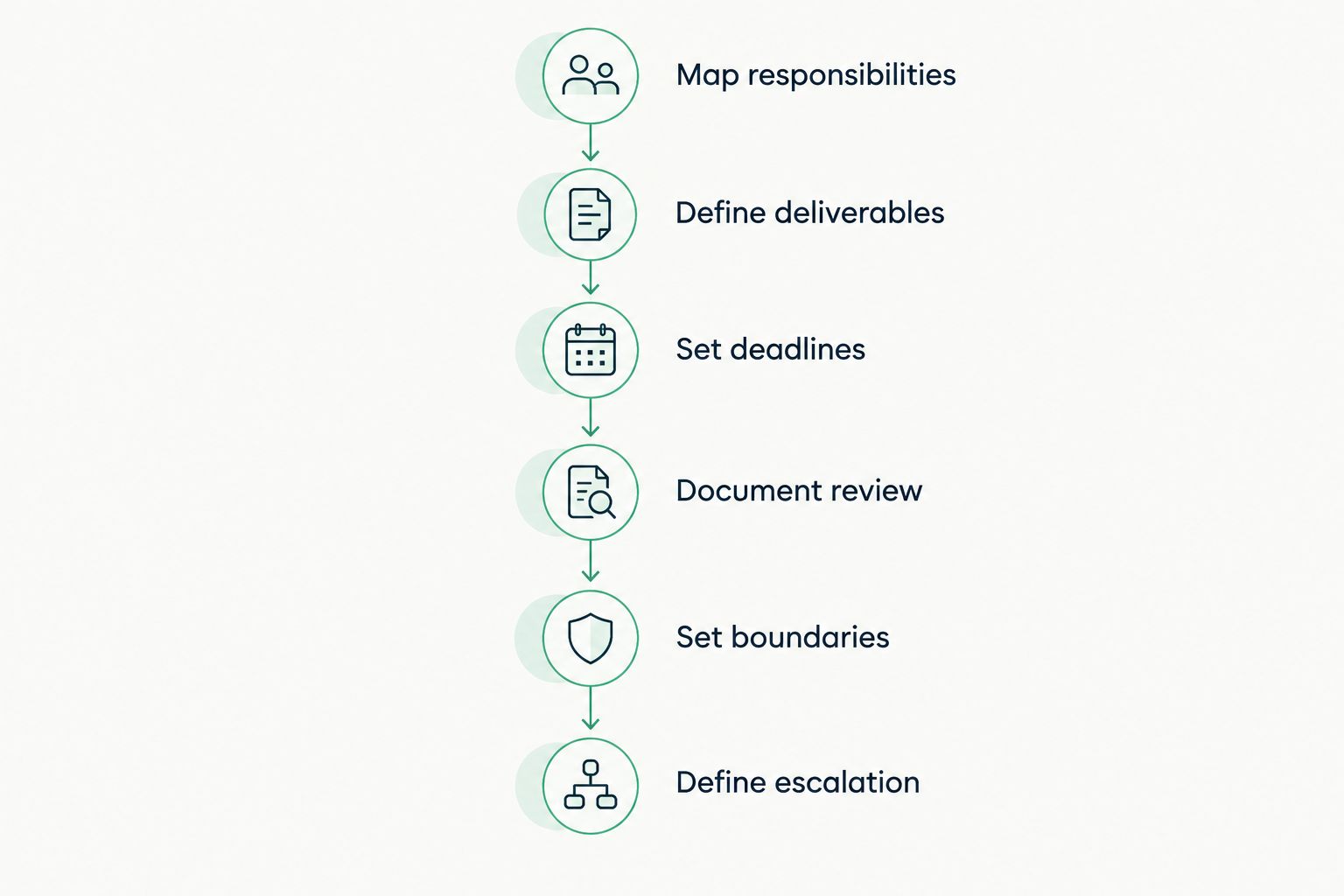
Define ownership and outputs before agreeing to the recurring close schedule.
What should your monthly controller package include?
Your monthly controller package should connect financial statements to the schedules and explanations supporting them. Request the outputs your business needs, and state whether the engagement includes preparation, review, or both.
Use this checklist when reviewing the proposed scope:
- Financial statements: Identify the balance sheet, income statement, and any cash flow reporting required.
- Account support: Define the reconciliation and supporting-schedule requirements for material accounts.
- Adjustments: Require a record of posted adjustments and the basis for significant estimates.
- Exceptions: List unresolved balances, missing documents, and decisions awaiting management.
- Review meeting: Specify whether a recurring discussion is included and who attends.
- Close evidence: Identify the checklist or status report confirming completion.
Do not accept reporting categories that your records cannot support. If project profitability matters, the scope must address project coding and the treatment of shared costs before promising a project-level report.
A useful acceptance test is simple: can your finance lead trace an important statement balance to its supporting schedule? If not, ask what additional documentation belongs in the engagement.
Why outsourced controller scope varies
The right scope depends on the accounting work your business actually requires. These factors change the responsibilities to document, even when providers use the same service title.
- Starting condition: Unreconciled accounts and unsupported opening balances require a transition plan separate from recurring work.
- Transaction workflow: Assign responsibility for collecting records, coding activity, resolving exceptions, and maintaining source documents.
- Accounting complexity: Inventory, revenue recognition, project accounting, and estimates require relevant schedules and review procedures.
- Reporting structure: Multiple entities, departments, locations, or projects need defined reporting categories and reconciliation responsibilities.
- Approval requirements: Payment authority, journal-entry approval, and access rights need clear boundaries between the provider and management.
- Decision support: Budgeting, forecasting, and financing analysis require explicit deliverables rather than an assumption that controller services include them.
For your 2026 scope, describe these factors as work requirements, not adjectives such as complex or full-service. A provider can respond to a defined reconciliation requirement; a broad label leaves room for disagreement.
How should the scope change for your business model?
Keep the core close process consistent, then add the schedules your operations require. The following are hypothetical scoping examples, not client results or statements about a particular engagement.
Construction: connect job records to reporting
If you need job-level reporting, assign responsibility for job coding, cost allocations, and contract-related schedules. State who supplies project updates and who reviews the accounting treatment.
Job reports are useful only when the underlying coding is maintained. Do not put the report in scope while leaving its inputs unassigned.
Healthcare: reconcile receipts and receivables
If collections arrive through different payment channels, define how receipts connect to receivable records and bank deposits. Assign ownership of timing differences, adjustments, and unresolved balances.
Keep accounting responsibilities separate from billing operations unless the agreement expressly includes both. Otherwise, a receivable problem can move between teams without resolution.
Ecommerce: reconcile settlements and inventory
If sales channels remit net settlements, specify how sales, deductions, refunds, and deposits are reconciled. Identify who supplies inventory records and approves inventory adjustments.
A bank deposit alone does not explain every component of a settlement. Require a reconciliation process that preserves those distinctions.
SaaS: separate cash receipts from revenue
If customers pay before services are delivered, define who maintains deferred-revenue schedules and reviews revenue recognition. If management needs monthly recurring revenue reporting, define that metric separately from financial-statement revenue.
Operational metrics and accounting balances serve different purposes. The scope should explain their sources and any reconciliation, rather than treating them as interchangeable.
What should you ask before signing the agreement?
Ask the provider to walk through a normal close and an exception. A normal close shows the planned process; an exception shows who takes responsibility when that process breaks.
Use these questions during your 2026 provider discussion:
- Who prepares each reconciliation, and who reviews it?
- Which documents must our team deliver, and by when?
- What specifically marks the close as complete?
- How are unresolved questions recorded and escalated?
- Which deliverables require separate authorization?
- Who retains access to records and schedules if the engagement ends?
Ask for answers in the agreement or its attached scope. A verbal explanation helps you understand the service, but written responsibilities give both teams a shared reference.
Discuss your controller scope
Bring your close checklist, reporting needs, and unresolved balances to a service discussion.
Does outsourced controller work include bookkeeping?
Outsourced controller work includes bookkeeping only when the agreement assigns transaction preparation and maintenance to the provider. Review the task schedule rather than relying on the service title.
If your internal team handles bookkeeping, specify how the controller receives completed work and returns corrections. Shared responsibility still requires a defined handoff.
Can you keep payment approval inside your business?
You can structure the scope so your business retains payment approval while the provider prepares accounting records or payment batches. Document access permissions and release authority separately.
Do not treat software access as evidence of approval responsibility. The agreement should identify who can prepare, review, and release each relevant transaction.
How do you separate cleanup from recurring controller work?
Separate cleanup by identifying the periods, accounts, and unresolved items requiring correction before recurring work begins. Give that work its own deliverables and completion criteria.
For a 2026 transition, establish how opening balances will be supported and approved. Otherwise, historical questions can remain embedded in each monthly close.
FAQ
What should an outsourced controller services agreement include?
An outsourced controller services agreement should include responsibilities, deliverables, deadlines, review procedures, client dependencies, exclusions, and escalation rules. Attach a task schedule showing preparation, review, and approval ownership.
What's the difference between a controller and a bookkeeper?
A bookkeeper maintains transaction records; a controller oversees the accounting process, close, and financial reporting within the agreed scope. Confirm preparation responsibilities because controller oversight does not automatically include bookkeeping execution.
Do I need a controller or a CFO?
Choose controller support when you need accounting oversight and a defined close; choose CFO support when you need forecasts, budgets, or financial decision support. Some businesses need both, with separate deliverables.
What does a monthly close by the 15th mean?
A monthly close by the 15th is ACE CPAs' stated service commitment. Your engagement should define the reporting period, required client inputs, completion criteria, and treatment of late information.
Should tax returns be included in controller services?
Tax returns should be included only when the agreement expressly assigns that work. Distinguish recurring accounting entries from tax preparation, filing, and advisory responsibilities.
How do I compare outsourced controller proposals?
Compare outsourced controller proposals against the same task schedule and reporting requirements. Check who prepares the work, who reviews it, which outputs you receive, and which responsibilities remain with your team.
What should I prepare for a controller consultation?
Prepare your current financial statements, close checklist, unresolved account questions, and required reporting outputs. Identify the decisions your current reports cannot support so the discussion stays focused on scope.
One last thing
Ask who owns the unfinished work. A scope can describe every scheduled task and still fail to assign responsibility for exceptions.
Before signing, choose an unresolved balance from your own records. Ask the proposed team to explain who investigates it, who supplies evidence, who approves the correction, and how it reaches the final statements. That walkthrough tests the scope more directly than a longer service list.
Related guides

How to compare fractional CFO services proposals
Compare fractional CFO services proposals by deliverables, staffing, forecasting, and handoffs. Use a practical checklist to choose the right scope.

How to choose outsourced accounting services for your business
Choose outsourced accounting services by checking scope, CPA review, close deadlines and handoffs. Use this checklist to compare teams before you sign.
How to scope outsourced controller services before signing
Scope outsourced controller services before signing. Define deliverables, close deadlines, review duties, exclusions, and approvals with a practical checklist.

How to switch outsourced bookkeeping services without losing records
Switch outsourced bookkeeping services without losing records. Use a clear handoff checklist to verify access, preserve files, and reconcile balances.
Why “Clean Books” Are Not Enough for Business Growth
Clean books are essential but not enough for growth. Learn why small business bookkeeping must add reporting, forecasting, and strategy to drive profit.

Why QuickBooks Online (QBO) Bookkeeping Services Are Essential for Small Businesses in the USA
Expert QuickBooks Online bookkeeping for growing US businesses. Accurate books, tax-ready reports & CPA oversight. Get a free consultation today.

When Is the Right Time to Hire a Fractional CFO?
Not sure if you need a fractional CFO? Learn the revenue milestones, cash flow signs & growth triggers that signal it's time. Read now.

Top 7 Financial Mistakes Growing Businesses Make After $500K in Revenue
Crossed $500K in revenue? Avoid the 7 financial mistakes that stall growing businesses, cash flow, pricing, tax & reporting errors. Read the guide.

Tax Planning vs Tax Filing: Why Most SMBs Overpay Taxes Every Year
Tax filing isn't tax planning. Learn why most SMBs overpay every year and how proactive planning with a CPA can lower your tax bill. Read more.
Proactive CPA vs Reactive CPA: Why It Makes or Breaks Your Business Growth
Reactive accountants cost you more than they save. See how proactive CPA services drive real growth through planning, not just paperwork. Learn more.

Cash Flow vs Profit: Why Profitable Businesses Still Struggle
Learn the key differences between cash flow and profit, why profitable businesses can face cash shortages, and how to improve financial stability.

Do You Need a Fractional CFO or Just a Bookkeeper? A Clear Breakdown for SMBs
Bookkeeper or fractional CFO: which does your business actually need? Compare roles, cost & when to hire each. Get expert guidance today.